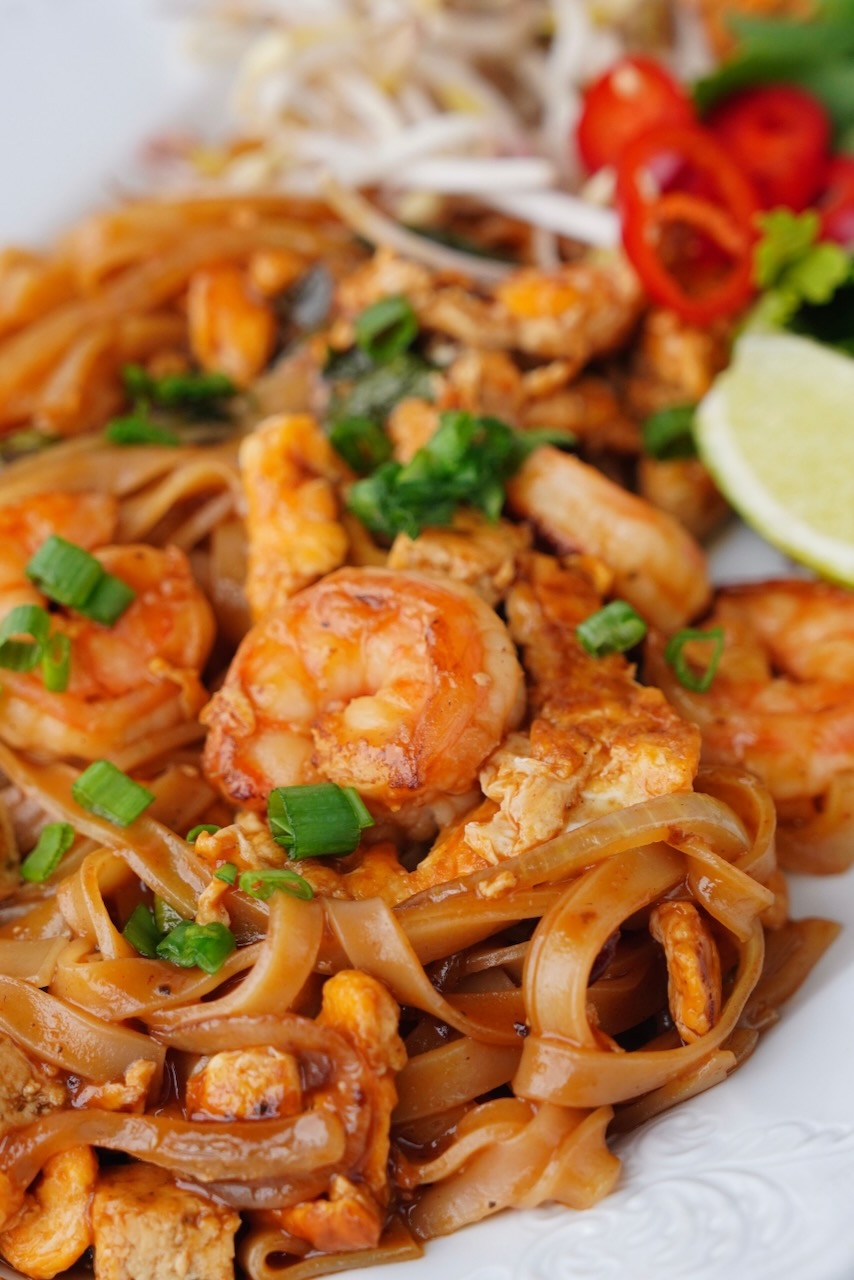
 Shrimp pad thai, this is a Thai classic rice noodle stir fry! Let’s make a silky and sugary sweet and zippy shrimp pad thai tonight for dinner!
Pad thai, you surely must have heard of it before!
It is probably the most popular Thai dish in the world.
And I can see why.
Silky soft rice noodles in a sweet and sour sauce. Bits of scrambled egg, crunchy peanuts, spring onion, crispy bean sprouts.
Thai Noodle Dinner
Who could say no to a meal like that!
So let’s make a silky and sugary pad thai tonight for dinner!
The pad thai sauce is more or less based on the pad thai recipe of my Thai friend Rose.
And she knows best what goes into it.
Palm Sugar
Don’t let the amount of sugar in this shrimp pad thai recipe put you off though.
The palm sugar is the most important ingredient that goes into this dish here. It is what keeps this dish together. Leave it out and you will end up with a bland stir fry. It is the combination of the sugar and tamarind that gives pad thai its particular flavor.
Have you ever been to Thailand before?
Easy Homemade Shrimp Pad Thai Recipe
Then you certainly must have tasted this dish there!
It is a very popular noodle stir fry over there. And we love it. What I love so much about it is the texture of the flat noodles. They are so good and have a lovely bite to them.
However I tasted another noodle stir fry in Thailand called pad see ew. The noodles in that dish are so silky smooth, my absolute favorite!
Tamarind
If you cannot find any tamarind juice, then you can replace it by a tablespoon of molasses and 2 teaspoons of lemon or lime juice.
Do you love cooking Thai food?
Then you should also check out my creamy chicken panang curry!
And how about my green papaya salad?
Enjoy!

Easy Shrimp Pad Thai Noodles
Shrimp pad thai recipe, a Thai classic noodle dish!
- 12 cooked shrimp
- 7,5 oz rice noodles (200 g), dry
- 3,5 oz bean sprouts (100 g)
- 1 large egg
- 1 batch fresh pad thai sauce (see below this recipe)
- 4 fresh spring onions chopped
- a handful fresh cilantro chopped
- a handful salted peanuts crushed
- ½ cup water (120 ml)
- 1 fresh lime
- 1 tbsp vegetable oil
1) Soak the dry rice noodles. See the specific package instructions.
2) Pour the the vegetable oil in a large non-stick pan and place it over medium heat until hot. Then add the egg.
3) Scramble the egg quickly and take the pan off the heat for now. Drain the soaked rice noodles and add them to the scrambled egg.
4) Stir a little. Then pour in the freshly made pad thai sauce and add 3 tablespoons of water.
5) Stir the noodles. Cover the pan and put it back over medium heat. Cook for 4 minutes until the noodles are tender. Stir regularly. Then add the cooked prawns and the chopped spring onions.
6) Stir the noodles again. Cook for another 4 minutes. Add extra water if the noodles are too dry. Then stir in the freshly chopped cilantro and the bean sprouts.
7) Stir the pad thai well to combine. Check the seasoning and add extra fish sauce or hot chili sauce to taste if necessary. Then divide the pad thai noodles and shrimp over warm and deep plates. Sprinkle with the crushed salted peanuts and serve with a wedge of lime on the side. Serve hot.

For the Pad Thai Sauce (1 batch)
This is the sweet‑tangy, glossy sauce that gives the shrimp pad thai its signature flavor.
It is based on the recipe I learned from my Thai friend Rose — simple ingredients, quick to make, and absolutely essential for that proper balance of palm sugar, tamarind and fish sauce.
If you enjoy bold, savory Thai flavours, you’ll also love my Thai basil pork — it’s quick, fragrant, and just as addictive.
Ingredients
- 1 tbsp vegetable oil
- 1 small onion, chopped
- 2 large garlic cloves, chopped
- 2 tbsp fish sauce
- 2.5 oz (70 g) palm sugar (or brown sugar)
- 1 tbsp hot chili sauce
- 2 tbsp tamarind juice
- 2 tsp oyster sauce
- ½ cup (120 ml) water
Method
1. Heat the vegetable oil in a small saucepan over medium‑high heat.
2. Add the chopped onion and garlic. Cook for 3 to 4 minutes until the onion softens.
3. Add the palm sugar, fish sauce, tamarind juice, oyster sauce and chili sauce.
4. Pour in the water and stir well.
5. Bring the mixture to a boil and let it reduce by half. You’re aiming for a glossy, slightly sticky sauce that still runs off the spoon.
6. Take it off the heat and set aside.
How to use it in the main recipe
Add 1 full batch of this freshly made pad thai sauce to the noodles when indicated in the shrimp pad thai recipe card above.
Where in Thailand is pad thai from?
Pad thai, also known as phat thai or phad thai, is a popular stir-fried rice noodle dish commonly served as street food in Thailand.
Its origins can be traced back to the Ayutthaya period in Thai history, around the 17th century.
Although stir-fried rice noodles were introduced to Thailand from China centuries ago, the dish pad thai was actually invented in the mid-20th century. It was created using rice noodles and was called pad thai as a way to galvanize nationalism during that time.
Today, it has become one of Thailand’s national dishes and is enjoyed by people all over the world!
Who invented pad thai?
During World War II, Thailand faced a rice shortage due to the war and floods.
To reduce domestic rice consumption, the Thai government, led by Prime Minister Plaek Phibunsongkhram, promoted the consumption of noodles instead. As a result, a new noodle dish called sen chan pad thai (named after Chanthaburi Province) was created.
This shrimp pad thai, made with rice noodles, shrimp, peanuts, scrambled egg and bean sprouts, eventually became known simply as pad thai.
There’s also a debate about whether shrimp pad thai and pad Thai in general was truly of native Thai origin. Some argue that it was invented by Chinese immigrants themselves, given that noodle cookery was introduced by waves of immigrants from southern China settling in the region.
What is a good substitute for palm sugar in this shrimp pad thai?
There are a few options you can consider:
- Light brown sugar: light brown sugar is an excellent substitute for palm sugar. It provides a similar level of sweetness without altering the flavor profile too much. Use it in the same quantity as you would palm sugar.
- Dark brown sugar: if you don’t have light brown sugar, dark brown sugar can work as well. However, keep in mind that it has a deeper molasses flavor, which might slightly affect the taste of your Pad Thai.
- Coconut sugar: coconut sugar is another alternative. It shares some similarities with palm sugar, including a natural sweetness and a hint of caramel flavor. Use it as a 1:1 replacement for palm sugar.