Vinegar on ice cream. It sounds like a joke, or like something a chef does to seem clever. And yet it is one of the most classic ways to serve balsamic vinegar in Emilia-Romagna, the region it comes from.
That alone tells you something. Because the thin, sharp, brownish liquid that sits in most kitchen cupboards is not really the same product as the dark, syrupy stuff those few drops come from. Not even a distant cousin.
Balsamic is probably the most misunderstood bottle in the pantry. It is also one of the easiest to get wrong at the shop, because two very different things are sold under names that look almost identical.
So let us clear this up once and for all, shall we? Here is everything you want to know: what balsamic vinegar actually is, how it is made, what those confusing labels mean, how to buy a bottle you will love, and what to do with it once you get it home.
So What Exactly Is Balsamic Vinegar?
It comes from Modena and Reggio Emilia, two provinces in the north of Italy. And here is the thing that surprises most people: unlike almost every other vinegar on the planet, it does not start with wine.
It starts with grape must. That means freshly pressed grapes, juice and skins and seeds all together, mainly Trebbiano and Lambrusco. The must is then cooked slowly in open vats until a good part of the water has evaporated and what is left is dark, sweet and syrupy.
Only then does it go into wood. And from that point on, time does the heavy lifting.
How It Is Made
The batteria
The cooked must is aged in a batteria: a set of wooden barrels lined up from biggest to smallest, each one made of a different wood. Oak gives structure. Chestnut gives tannin and color. Cherry gives sweetness. Mulberry, ash and juniper each add their own aromatics.
Once a year a small amount is drawn from the smallest barrel, and that barrel is topped up from the one above it, and so on down the line. Nothing is ever emptied completely, which means an old batteria always contains a little bit of every year that came before it. I love that idea.
Why the attic matters
The barrels live in an acetaia, traditionally in the attic of the house, with no temperature control at all. Hot Italian summers push evaporation and concentration. Cold winters slow everything down and let the vinegar settle. Those swings are not a problem to be solved, they are the whole point.
IGP or DOP? What Those Labels Actually Mean
This is where most shoppers get lost, so let us keep it simple. There are two protected products and they are not the same thing.
Aceto Balsamico di Modena IGP
This is the bottle you will find in most shops. It is a blend of cooked grape must and wine vinegar, aged for a minimum of sixty days, or at least three years if the label says invecchiato. Quality varies enormously in this category, from genuinely lovely to frankly sugary. That is exactly why reading the label matters.
Aceto Balsamico Tradizionale di Modena DOP
This is the treasure. Cooked grape must only, nothing added, aged a minimum of twelve years, and twenty-five years for the extra vecchio. It is sold in a distinctive little round 100 ml bottle and it costs what a good bottle of wine costs. And yes, this is the category that ends up on the ice cream.
How to Buy a Bottle You Will Actually Love
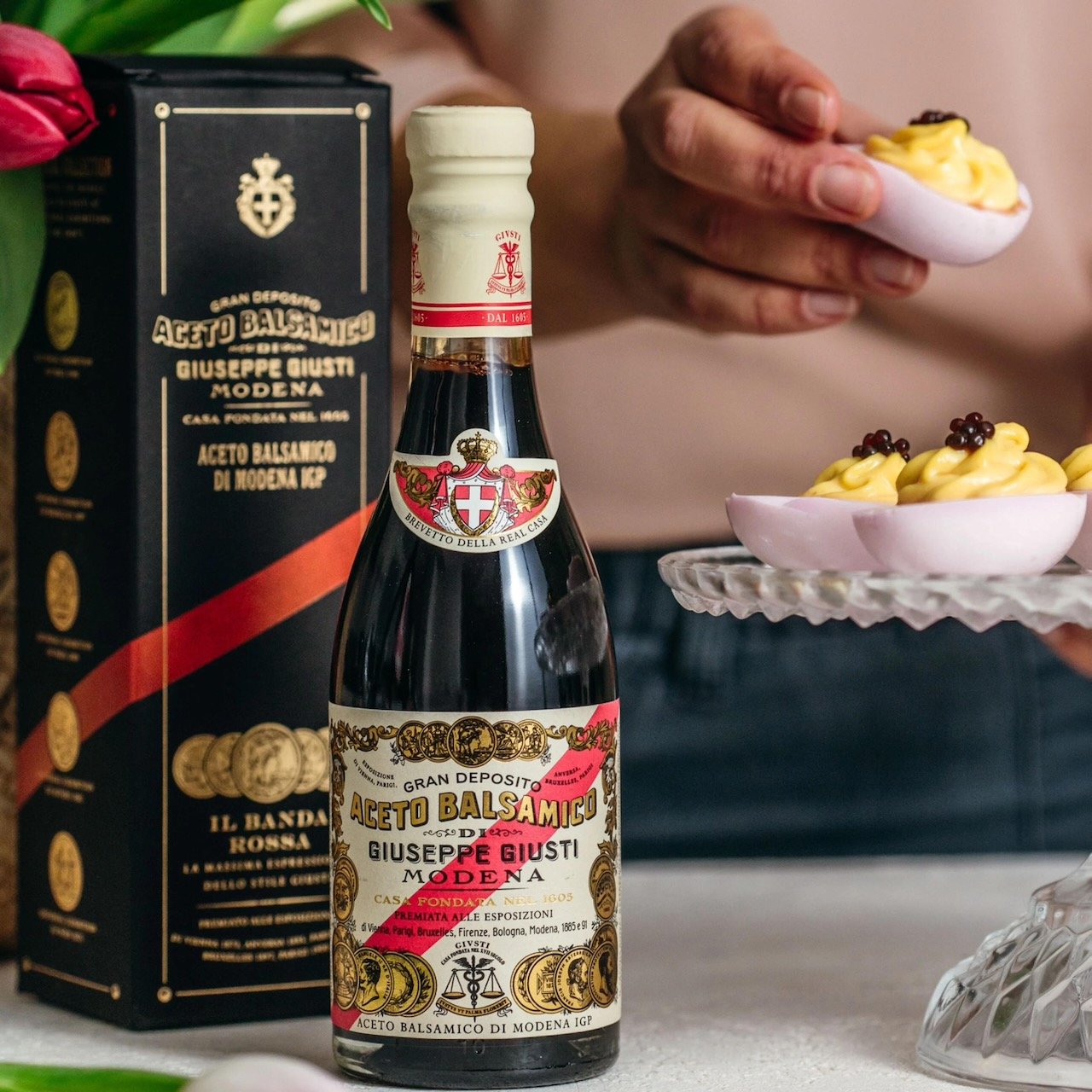
Here is the good news: you do not need to spend a fortune to get something decent. But you do need to read the back of the bottle. A real balsamic vinegar, like the balsamic vinegar of Modena by Giusti, lists cooked grape must first and tells you plainly how long it has been aged. That is the level of transparency to look for, whatever brand ends up in your basket.
A few things I always check:
The ingredients list. Cooked grape must should come first, or at least be there in a meaningful amount. If caramel coloring is doing the work, you will taste it.
- The consistency. Tilt the bottle. The liquid should cling to the glass and slide back slowly, leaving a visible trail behind it.
- The seal. Look for the Consorzio certification mark. It is not a guarantee of greatness, but it does tell you the rules were followed.
- The price. A three-euro liter bottle cannot contain years of barrel aging. The math simply does not work.
- The size. Skip the giant bottle. You want a small one you will finish while it is still at its best.
Young or Aged: Which One Do You Need?
Both, ideally. They do completely different jobs in my kitchen.
The younger, thinner, sharper bottle is my workhorse. It goes into vinaigrettes, marinades and pan sauces, where it will be diluted, reduced or cooked anyway. No need to be precious about it.
The older, denser bottle never sees real heat. It gets poured by the drop, right at the end, on things that are already cooked or already perfect on their own. Using a twenty-five year old vinegar in a marinade is a bit like using Champagne to deglaze a pan. You can. But why?
What I Actually Put It On
Once you stop thinking of balsamic as a salad thing, it goes everywhere:
- Vanilla ice cream, obviously. Start here if you have never tried it
- Strawberries, with a little black pepper and a pinch of sugar
- A wedge of aged Parmigiano, no bread, no plate, just standing at the counter
- Roasted vegetables, brushed on in the last five minutes so it does not burn
- Stirred into a risotto right at the end, off the heat, with the butter
- Grilled peaches or figs, which is my favorite thing about late summer
How to Store It
Nothing complicated here. Keep it upright, in a cupboard, away from the stove and out of direct light, because heat and brightness flatten the aromatics. Do not put it in the fridge, the cold dulls the flavor and thickens the texture in a way that helps nobody. It will not spoil once opened, but it is at its most expressive within a year or two.
One Last Thought
If there is one habit worth changing, it is this: stop treating balsamic as a condiment you keep behind everything else and start treating it as an ingredient. Move the bottle to the front of the shelf, right next to your olive oil and your salt. Taste it on its own once, from a teaspoon, so you know what you are working with.
And if you have never tried those few drops on vanilla ice cream, start there. It is the fastest way to understand what all the fuss is about.