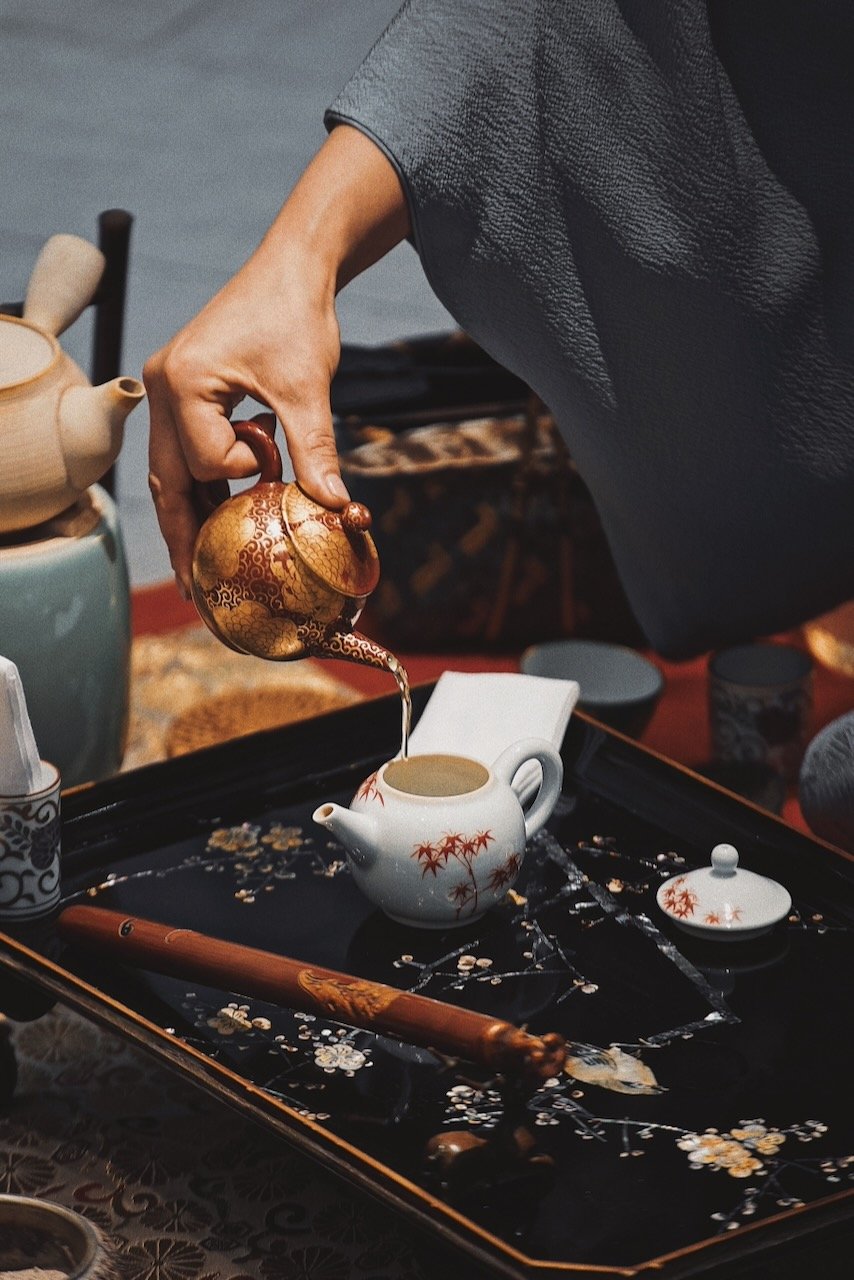
If you cook Japanese food at home, there is a good chance a bag of sencha or a tin of matcha is sitting somewhere in your kitchen. Green tea is part of the Japanese table as naturally as miso, rice or dashi.
For many Europeans and Americans, though, Japanese tea culture still begins with a mental image: silent rooms, slow movements, perfect ceramics. Those who travel through Japan quickly realise that tea there is far more than a ritual.
Tea is everyday life, craft and agriculture. And often also a way into a different understanding of time.
Between mist, mountains and tea fields
In regions such as Shizuoka, southwest of Tokyo, tea plantations shape entire landscapes. Between gentle hills, endless rows of bright green tea bushes stretch through the mist. A large share of Japanese green tea is produced here, including sencha, by far the most widespread tea in Japan.
Unlike many Chinese green teas, which are often pan fired, Japanese green tea is usually steamed briefly after harvesting to stop oxidation. This helps preserve the fresh, vegetal, almost grassy flavour of a good sencha, the same flavour that makes it such a good companion to Japanese food.
“For travellers, this is often the moment when tea becomes real. They realise that sencha is not a standard flavour, but something shaped by landscape, season and craftsmanship. When you stand in a tea field in Shizuoka and then taste the tea made from those leaves, you understand the connection immediately,” says Jeremy Batt, Product Manager at Japanspecialist.
It gets particularly interesting where tea culture is not just explained, but experienced. In Shizuoka, smaller farms offer visits where guests can pick tea leaves themselves, taste freshly processed leaves or learn step by step how traditional sencha is made.
Why tea in Japan is more than a drink
In Japan, tea is part of a broader culture of attentiveness: the architecture of ryokans, seasonal cooking, ceramics, gardens and the way time is consciously shaped.
Many travellers find exactly these encounters the most intense: the scent of freshly steamed tea leaves, a cup of sencha overlooking misty hills, or conversations with producers whose families have done this work for generations.
“What makes these farm visits so memorable is that guests stop seeing tea as a product on a shelf. They meet the people behind it, smell the leaves while they are being processed and understand how much knowledge sits in every small decision. That is very different from simply ordering green tea in a restaurant,” says Manuel Meister, Travel Consultant at Japanspecialist.
This fits a development specialist travel providers have been seeing for several years: many Japan travellers are looking less for “must sees” and more for authentic, culinary experiences. That is why providers like Japanspecialist increasingly build them into individual itineraries, for example tea farm visits in Shizuoka, nights in a ryokan with seasonal kaiseki cuisine or regional cooking workshops away from the classic tourist trail.
The longing for authentic Japan
Especially with culinary themes, the value of specialist planning becomes clear. Many of these places would be hard for international guests to reach on their own, whether because of language barriers, regional particularities or simply a lack of information in English.
“One of our German travellers told me that taking part in an authentic tea ceremony became one of the most meaningful memories of her trip to Japan. What stayed with her most was the feeling that she would never have discovered that place, or understood those cultural details, if she had planned the journey entirely on her own,” says Stefanie Bulau, Travel Consultant at Japanspecialist.
And there is something else that surprises many visitors: how naturally Japan combines tradition and modernity. Between high speed trains, megacities and neon lights, there are regions where centuries old crafts are still part of everyday life.
Sometimes a cup of tea tells you more about a country than many a famous sight.
About Japanspecialist
Japanspecialist, formerly known as JTB Germany, is a global travel agency and part of JTB Corporation. Under one global brand, we bring together decades of local expertise and combine in-depth cultural knowledge with international reach.